Skyline University Nigeria

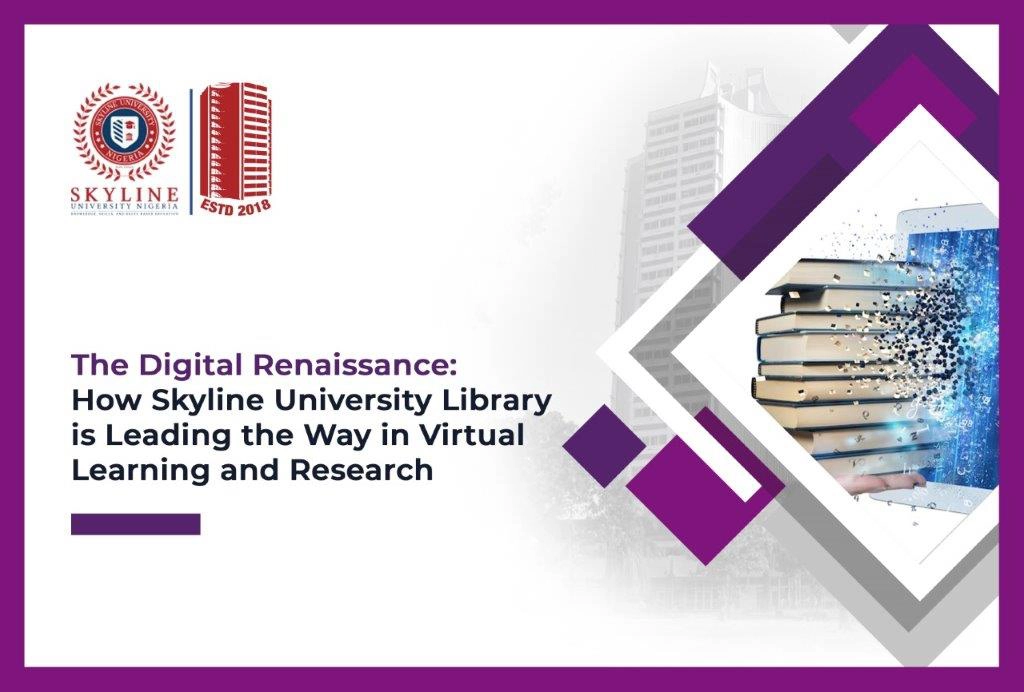
The Digital Renaissance: How Skyline University Library is Leading the Way in Virtual Learning and Research

Introduction The history of Skyline University Library complex and its collections parallels the history of the University itself. As the institution grew and the Faculties came on board in accordance with its strategic plan and the National University Commission’s approvals, the scope and nature of the Library’s collections developed, it became more physically distributed and expanded in complexity and richness according to disciplines and formats. Aside the physical collections academic institutions must evolve to meet the changing needs of students and faculty. Skyline University Library has not only adapted to this digital age but has emerged as a trailblazer, seamlessly integrating modern technology trailblazer, seamlessly integrating modern technology with the academic environment. This article highlights some of the intriguing and unique digital services that set Skyline University Library apart. Skyline University Library Mandate The main mandate of Skyline University Library support teaching, learning, and research in the University, by developing and promoting access to information resources, it strives to position itself among the leading academic libraries in the country as well as the world. The Skyline University Library pride itself with the following functions in line with the major objectives of an Academic Library (Shehu, Singh and Ochepa, 2020). Supporting research: Skyline University Library provide access to a wide range of resources, including books, journals, electronic databases, and other research materials. These resources are critical for conducting academic research and essential for students and faculty to stay up-to-date on the latest developments in their fields. Promoting academic success: Skyline University Library plays a crucial role in promoting academic success by providing students with the tools they need to succeed in their studies. They offer access to resources supporting learning, such as textbooks, study guides, academic journals, e-resources, learning modules, etc. Fostering intellectual curiosity: Skyline University Library promote intellectual curiosity by providing access to a wide range of reading materials. They offer books and other resources on a broad range of topics, encouraging students to explore new areas of knowledge and expand their horizons. Encouraging lifelong learning: Libraries are important for promoting lifelong learning, as they provide access to resources that allow individuals to continue learning long after they have left the classroom. This is particularly important in today’s rapidly changing world, where individuals must constantly update their skills and knowledge to stay competitive. Supporting the community: Skyline University Library provides resources, provides conducive space for students, faculty, and community members to learn and collaborate they offer study spaces, meeting rooms, silent zone, and other resources for community members, to further foster community relationship it has signed various MOUs with other Academic Libraries to further enrich their collections and support community which it is situated. Preserving knowledge: Skyline University Library plays an important role in preserving knowledge, as they serve as a repository for valuable research and historical documents, including government documents, they ensure that these resources are preserved for future generations and provide access to them for researchers, scholars, and students. From the onset, Skyline University Library has given priority to building an ultra-modern first-class Library, bearing in mind that a university can only be as good as its Library -‘the Library being the heart-beat of any academic institution’ (Shehu and Singh,2019). Consequently noting that integration of ICT to the Library Service will improve service delivery and clientele satisfaction. Skyline University Library’s Innovative Approach The digital revolution in education is undeniable, and Skyline University Library has been at the forefront of this transformation. Rather than seeing technology as a threat to the traditional library, Skyline has harnessed its power to enhance the learning and research experience for all. Below are some of the unique services Virtual Learning Resources One of Skyline’s standout features is its extensive collection of virtual resources. Students and faculty can access a treasure trove of e-books, e-journals, and digital databases from the comfort of their devices. The library’s user-friendly interface ensures that information is just a click away. In addition the library has full subscriptions to various databases such as Ebscohost, Proquest, IGI, J- store and Discipline-specific such as Legalpeadia, Law Pavillion, IEE, etc Virtual Reality (VR) and Augmented Reality (AR) Perhaps one of the most intriguing aspects of Skyline’s digital services is its embrace of virtual and augmented reality. With VR headsets and AR applications, students and faculty can engage in immersive learning experiences. Imagine dissecting a virtual cadaver or exploring ancient ruins—all within the confines of the library. Students can immerse themselves in the Library collection, resources, and voice query using Alexa chart box real-time Cutting-edge Research and Learning Tools For academics and researchers, Skyline University Library offers a suite of cutting-edge research tools and software. From data analytics platforms to specialized databases, to learning management systems, scholars have the resources they need to push the boundaries of knowledge. Telepresence robots in libraries Telepresence is the use of technology to simulate physical presence in a remote location. Skyline University Library offers virtual tour telepresence view of the library at https://bit.ly/3iH62om regardless of location, at the same time Library houses a Robotics Lab for student practical’s. Remote Learning and Support Services Skyline recognizes that learning does not always happen within library walls. That’s why it provides comprehensive remote learning support services. Students can receive reference assistance, attend online tutorials, and participate in webinars, ensuring that academic support is accessible no matter where they are. Conclusion Skyline University Library stands as a testament to the power of combining modern technology with the academic environment. Its digital services not only bridge the gap between the two but also elevate the entire educational experience. As Skyline continues to innovate and adapt, it reaffirms its commitment to shaping the future of education. Dr. Abdullahi Bala Shehu is an esteemed academic and visionary leader in the field of Library and Information Science, laced with an impressive academic journey and a wealth of experience, Education and Expertise. References Shehu, A. B., & Singh, K. P. (2022). Application of Information and Communication Technologies in Select Private University Libraries of North-Central Nigeria. Journal of Indian Library Association, 57(2), 1-13.
The Digital Renaissance: How Skyline University Library is Leading the Way in Virtual Learning and Research Read More »

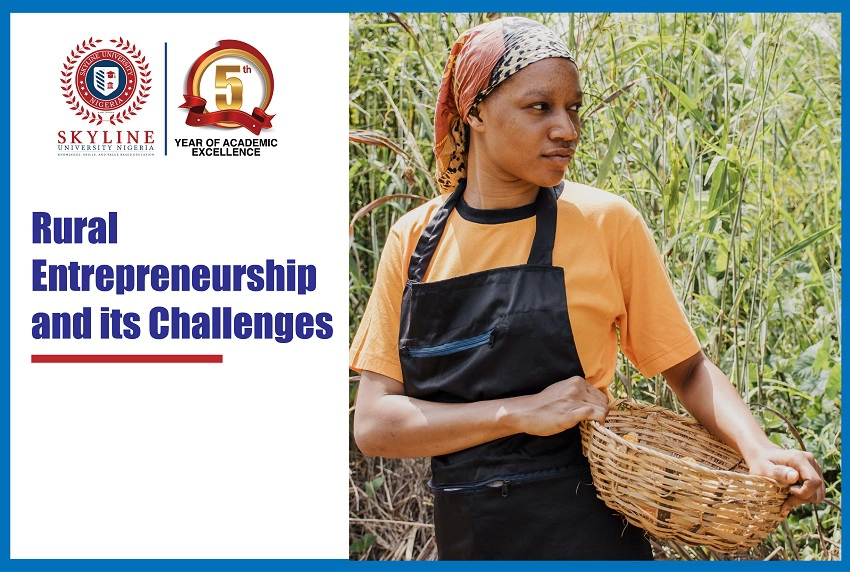
Rural Entrepreneurship and Its Challenges

Introduction The process of starting and running new businesses or ventures in rural areas is referred to as “rural entrepreneurship.” Entrepreneurship in the countryside is an important factor in the growth of a region’s economy because it can lead to job creation, higher incomes, and overall economic expansion. Rural entrepreneurship, on the other hand, faces a number of obstacles that limit its impact. This calculated paper expects to investigate the difficulties and chances of the rustic business venture. In addition, the provincial business venture is likewise affected by the social and social attributes of country networks. Rural entrepreneurs’ success may be significantly influenced by their community ties and social networks. According to Malecki & Oinas (2016), these networks can offer emotional support and encouragement, access to resources, customers, and other important stakeholders, and more. To help rustic businesses, there are a few strategy intercessions that can be executed. To encourage private investment in rural areas, one strategy is to offer financial incentives like grants or tax credits. In order to provide support services to rural entrepreneurs, another strategy is to establish partnerships between the public sector, the private sector, and non-profit organizations (Swanson, 2017). Obstacles to Rural Business Ownership     1. Access to capital is restricted: Limited access to capital is one of rural entrepreneurship’s biggest obstacles. Due to the lack of formal financial institutions and the limited venture capital available in rural areas, entrepreneurs in rural areas have difficulty obtaining financing for their businesses. 2. Absence of infrastructure: Due to a lack of infrastructure, entrepreneurs in rural areas face additional challenges. It is difficult for entrepreneurs to succeed in rural areas because they frequently lack reliable transportation, communication networks, and essential utilities like water and electricity. 3. Limited market opportunities: Rural business owners face a lack of market opportunities as a result of their small size and limited access to larger urban markets. Because of this; small businesses in rural areas have less room for expansion and find it more challenging to compete with larger, more established businesses. 4. Restricted HR: It can be hard for entrepreneurs in rural areas to find and keep talent because of the lack of human resources, such as professionals and skilled workers. Rural entrepreneurship is influenced by more than just the aforementioned opportunities and challenges. One significant element is the administrative climate. Rural entrepreneurship can also be hindered by regulations designed to protect the environment or public health. Barnes & Clancy (2019) say that rules about how to use water or land can make it harder for rural entrepreneurs to start and grow their businesses. The accessibility of support services is yet another crucial aspect. Support services like business development centers, mentoring Programmes, and networking opportunities are frequently unavailable to entrepreneurs in rural areas. According to Brown & Edwards (2017), rural entrepreneurs may need access to these resources in order to launch and expand their businesses successfully. Rural Entrepreneurship Possibilities          1. Agricultural business ventures: Due to their abundance of land and natural resources, rural areas are ideal for agricultural entrepreneurship. Horticultural businesses can assist country regions with enhancing their economies and set out new positions to open doors. 2. Entrepreneurship in tourism: Tourists are drawn to rural areas because of their natural beauty and cultural heritage. The travel industry business can assist provincial regions with profiting from their remarkable assets and making new income streams. 3. E-commerce: Entrepreneurs in rural areas now have new opportunities to reach larger markets without the need for physical infrastructure thanks to the rise of e-commerce. 4. Energy from the sun: Country regions are appropriate for sustainable power ventures like breeze and sun-based power. Rural communities may be able to benefit from these projects by creating new employment opportunities. In conclusion, entrepreneurial activity in rural areas has the potential to significantly enhance the economic growth of these areas. Rural entrepreneurship, on the other hand, faces a number of obstacles, including a lack of infrastructure, limited market opportunities, restricted human resources, and restricted access to capital. In any case, there are valuable open doors for rustic business ventures, including horticultural business, the travel industry business, web-based business, and environmentally friendly power. Policymakers and partners can uphold rustic business by giving admittance to capital, creating a framework, advancing business sector improvement, and putting resources into HR advancement. Conclusion In conclusion, rural entrepreneurship entails both difficulties and opportunities for rural economic growth. Rural entrepreneurship can benefit from e-commerce, renewable energy, agricultural entrepreneurship, and tourism entrepreneurship, and the lack of infrastructure, market opportunities, and human resources are critical obstacles. By removing regulatory obstacles, facilitating access to support services, encouraging partnerships, and providing financial incentives, policymakers and stakeholders can play a crucial role in supporting rural entrepreneurship. Mr Aliyu Mohammed is Lecturer II of the Department of Management, School of Arts, Management and Social Science, Skyline University Nigeria.  You can join the conversation on Facebook @SkylineUniversityNG and on Twitter @SkylineUNigeria

Rural Entrepreneurship and Its Challenges Read More »

Train the Trainer; SUN conducts Executive Seminar for Private School Proprietors and Principals

The management of Skyline Univerisity Nigeria (SUN) has conducted an executive seminar for all registered Private School Proprietors and Principals of North–West zone in Nigeria. The seminar was organized to empower them with the essential skills required for providing qualitative and inclusive education.  The event was themed ‘Leading and Managing Business for Value Creation, Managing Special Students and Digital Skills’ to incorporate all the current challenges faced by private school owners as education demands are transforming rapidly. In his welcome address, the Vice-Chancellor of SUN, Prof. Ajith Kumar V. V. thanked attendees for sparing their valuable time to attend the workshop. He said, “Every leader of education must stand on the principles of ethics and value. Do not compromise on the quality of education you give”.  He added that the success of students is everything to teachers, principals and mentors. He emphasized that proprietors and principals must not only teach for grades but teach skills, computer literacy, public speaking, etc. They must prepare students for future opportunities through rigorous training and insightful experiences.  During his presentation on inclusive education, Dr. Isah Usman, the Dean of the School of Basic Medical Science (SBMS), advised the participants to think of ways to integrate children with special needs in their schools. He said the children need extra care and are important contributors to national development.  Dr. Usman charged them to start the effort of making an impact gradually, to transform the existing status quo. He said schools are supposed to be changers. Every member of society must be good enough to support that desired change. Delivering his lecture on Digital Skills, the Dean School of Science and Information Technology (SSIT) Dr. A. Senthil Kumar said Digital Skills are crucial for managing schools. He said the skills do not only ease the affairs of schools in aspects of administration but also teaching and learning.  In her closing remarks Ms. Sarada Maganti, the Director of Academic Support Services (DASS), stated that the university is engaged in many community service activities and will continue to support communities. She admitted that SUN provides business mentorship opportunities and career development seminars for students and people with special needs among many others.  You can join the conversation on Facebook @SkylineUniversityNG and on Twitter @SkylineUNigeria

Train the Trainer; SUN conducts Executive Seminar for Private School Proprietors and Principals Read More »

Skyline University Nigeria organizes Team-Building Workshop for Cellopack Industries Staff

The management of Skyline University Nigeria (SUN) has recently conducted a team-building workshop for the employees of Cellopack Industries Limited at the SUN campus. The workshop was delivered by the Vice-Chancellor of SUN, Prof. Ajith Kumar V.V. The session was done to expose the participants to innovative knowledge, skills, and capabilities in an engaging session to enable them to network and communicate with one another so as to deliver their tasks efficiently as a team. The workshop also included games to unveil the importance of team-building. In his inaugural remarks, the Vice-Chancellor said the success of every dependable team is defined by specific qualities – Competence, Trustworthiness, Energy, People skills, Focus, and Judgement. He emphasized the significance of understanding the personalities of individuals so as to match them with the appropriate tasks and peers. While delivering the lecture, he highlighted that there are two specific sets of people found within any team in an organization which are Promotional-Focused People and Prevention–Focused People. The first set are optimists while the second is stressed by short deadlines.  He added that organizational Success is guaranteed when these two sets are carefully identified. The Managing Director of Cellopack Industries Limited Ms. Yashika Keswani thanked the management of the University on behalf of the team, for the wonderful initiative and hoped to invest the knowledge they have acquired to develop a highly competent and motivated workforce that will strengthen the overall performance of the team members. You can join the conversation on Facebook @SkylineUniversityNG and on Twitter @SkylineUNigeria 

Skyline University Nigeria organizes Team-Building Workshop for Cellopack Industries Staff Read More »

SUN Teaching Effective Committee conducts Faculty Development Workshop

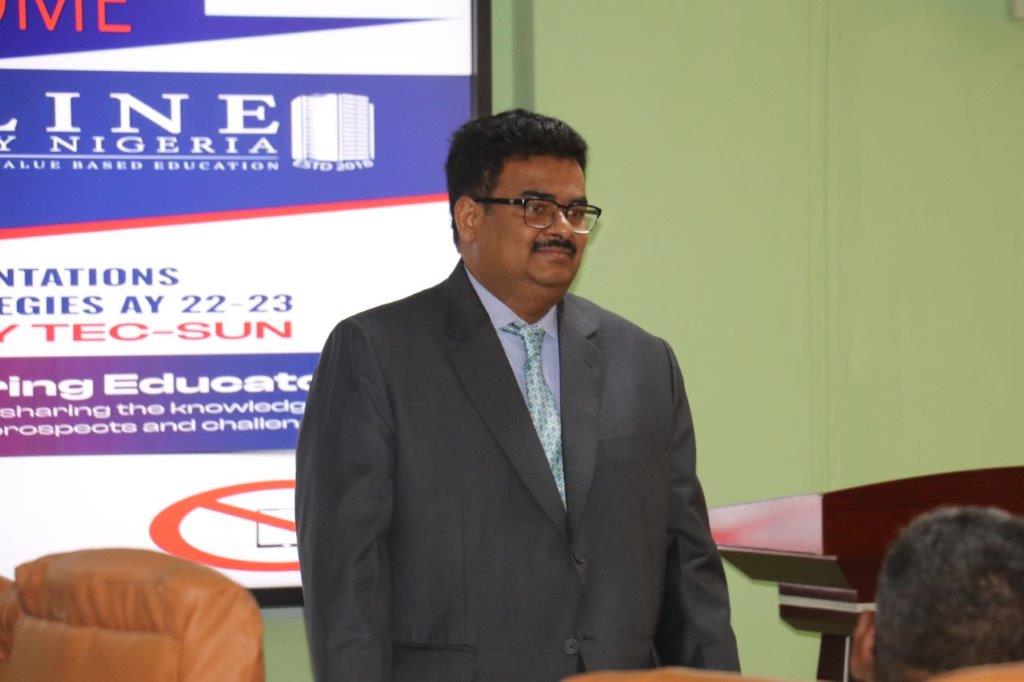
The Teaching Effectiveness Committee (TEC) of Skyline University Nigeria (SUN) has organised an internal development workshop to empower the Faculty of the University on effective teaching pedagogies. The session was conducted to enable the faculty to share their academic strategies and implementation challenges for the 2023/2024 academic year and learn from the successes of their peers. The presentations revolved around the theme “Empowering Educators: Transforming Learning through Sharing the Knowledge of Effective Academic Strategies – Prospects and Challenges”. In his opening address, the Vice-Chancellor of SUN Prof. Ajith Kumar V. V. expressed his delight that the workshop is capable of giving attendees valuable insights on how to implement successful academic strategies, especially through peer learning and knowledge sharing. He said the event exhibited the right energy for the qualitative education provided by the institution. At the core of their activities, the Vice-Chancellor reminded the faculty to groom students by shaping their future eloquently.  He then acknowledged the fact that teaching is a noble profession and charged the faculty to be role models and sources of inspiration as they prepare the future generation. He also tasked them with the responsibility of instilling basic etiquette in their students such as time management, emotional intelligence and self-discipline among others. Delivering his presentation Dr. Isah Usman, the Dean School of Basic Medical Sciences (SMBS) who is also a member of the TEC committee, highlighted the necessity of segmenting the students’ level of understanding when delivering lectures. He explained that the quality of any effective teaching has a strong connection with motivating and inspiring students to learn.   In their various presentations, the faculty of the School of Arts Social and Management Sciences (SAMMS), the School of Basic Medical Sciences (SMBS) and the School of Science and Information Technology (SSIT), explained the various teaching pedagogies they have experimented and underlined their successes and challenges. Project-based learning and flip-teaching were among the methodologies that dominated the discussions. A total of 22 faculty members presented during the workshop.   In her closing remarks, the Dean School of Arts Social and Management Sciences (SAMMS) and the chairperson of TEC Dr. Sudha Mavuri, conveyed her satisfaction with the presentations delivered by the Faculty concerning student engagement, assessment methods, technology integration, and differentiated instruction. Dr. Mavuri added that knowledge sharing by the faculty is essential to advancing the transfer of knowledge. She said it is crucial for the faculty to experiment with at least one teaching pedagogy in an academic session.  One of the participants of the session Mr. Trimisiyu Lawal, a lecturer from the Department of Economics said he was successful in applying the flip-teaching method. He said he was inspired to do so after attending the TEC session that happened during the last academic year 2022/2023, where one of the faculty explained its significance in teaching. You can join the conversation on Facebook @SkylineUniversityNG and on Twitter @SkylineUNigeria

SUN Teaching Effective Committee conducts Faculty Development Workshop Read More »

NYSC conducts pre-mobilization orientation for SUN Final Year Students

The National Youth Service Corps (NYSC) has conducted a premobilization orientation for the Prospective Corps Members (PCMs)/Final year students at Skyline University Nigeria (SUN). The orientation session was held at the campus of SUN. The session was delivered by Mr. Musa T. Kafarda, the Assistant Director of Mobilization at NYSC headquarters FCT Abuja. He said some of the staff of NYSC have been tasked with the duty of delivering the pre-mobilization training for prospective corps members in selected Public and Private Universities across Nigeria including SUN. In his remark, the Vice-Chancellor of Skyline University appreciated NYSC for supporting the students. He said the information delivered will be resourceful and effectively utilized by the students to have an easy service year. Mr. Kafarda said “The briefing is to prepare the PCMs for a hitch-free service year and give them first-hand information on the activities of the NYSC. It also enables Corps Producing Institutions and their students to get clarification on issues of importance”. He explained that NYSC began in 1973 after the Nigerian Civil War which is about 54 years to date. He said the administration of former President Yakubu Gowon established it in order to inculcate discipline so as to rehabilitate and construct a unified country. He added that the pre-mobilization training sessions are important for PCMs so as to experience a hitch-free before, during and after service year. He highlighted that the NYSC experience involves physical and rigorous activities that are not applicable for some sets of candidates including pregnant mothers, people with special needs, sickness, etc. There are also criteria for exemption applied by NYSC when necessary. Mr. Kafarda then advised the PCMs/Final year students at SUN to abide by all rules set down by the NYSC so as to benefit immensely from the life-changing experience. He said the NYSC experience will acquaint corps members with opportunities for skills acquisition, self-meditation, networking, and language studies among other valuable benefits. One of the final year students of Computer Science at SUN Ms. Anisa Sagir who attended the session said, the session was really satisfying and she learnt a lot. She says now knows the requirements need and hopes to have a fruitful service year. You can join the conversation on Facebook @SkylineUniversityNG and on Twitter @SkylineUNigeria

NYSC conducts pre-mobilization orientation for SUN Final Year Students Read More »

Train the trainer; SUN conducts Seminar on Stress Management and Transformational Leadership

Skyline University Nigeria (SUN) has concluded the Train the Trainer executive seminar for Directors, Deputy Directors and Senior Administrators from the Ministry of Education in Kano State. The two-day session which ran from runs from the 26th to the 27th of July 2023 is part of the numerous Corporate Social Responsibility (CSR) activities done by the institution. In his remarks, the Vice–Chancellor of the university Prof. Ajith Kumar V. V. said the topics selected were deliberately curated to support the work of the administrators in discharging their duties. He expressed his satisfaction with the performance of the participants through interactive engagements and careful reviews. He assured them of the university’s unwavering support and readiness to help them enhance their productivity. The Permanent Secretary of the Ministry of Education Kano State, Hajia Kubra Imam who attended the event appreciated the Directors, Deputy Directors and Senior Administrators for attending the life-long impactful workshop. She said the training will help the executives in giving education a new dimension in the state. The second day of the seminar uncovered the essentials of stress management and transformational leadership. The Dean School of Basic Medical Sciences (SBMS) Dr. Isa Usman engaged the participants on an exciting journey of Stress, its causes and coping mechanisms. He said stress is inevitable but manageable. He highlighted several stressors from personal experiences while interacting with the attendees. He then urged the participants to prioritize their mental health. Dr. Sudha Mavuri, the Dean of the School of Arts, Management and Social Sciences (SAMSS) disclosed the need for a transformational leadership style for the participants. She said leaders and followers are bound together in a transformation process. She added that transformational leaders enable leaders to model the ways, challenge processes and inspire a shared vision. The first day of the workshop exposed the participants to the relevance of learning and applying Digital Skills in their everyday executive activities. The tutors from the School of Sciences and Information Technology (SSIT) informed the attendees about the significance of acquiring IT skills which are necessary to support and improve the efficiency of their work. They added that the skills will also reduce the stress they experience while delivering their tasks. In her closing remarks, the Director of Academic Support Services (DASS) Ms. Sarada Maganti conveyed her joy over the successful completion of the session. She said the university will continue to contribute to the betterment of education in Kano. You can join the conversation on Facebook @SkylineUniversityNG and on Twitter @SkylineUNigeria  

Train the trainer; SUN conducts Seminar on Stress Management and Transformational Leadership Read More »

Train the Trainer; SUN conducts Executive Empowerment Seminar on Digital Skills

Skyline University Nigeria has conducted the first day of executive empowerment seminar for Directors, Deputy Directors and Senior Administrators from Ministry of Education, Kano State on Digital Skills. The workshop which runs from the 26th to the 27th of July 2023, is part of the Corporate Social Responsibility (CSR) of the university. In his remarks, the Vice-Chancellor of SUN Prof. Ajith Kumar V. V. said that it was a pleasure having the executive participants on the campus as he welcomed them. He encouraged them about the necessity of learning digital skills due to their strategic positions in the Ministry. He acknowledged that the executives have a huge role to play in educating their peers and co-workers. The Vice-Chancellor admitted that educating them will help the various educational sectors in Nigeria to catch up with global technology and innovation trends. He then thanked the participants for all the support they have extended and informed them about the Skyline University School of Post-Graduate Studies. Ms. Sarada Maganti, the Director of Academic Support Services (DASS) in her speech thanked the executive participants for sparing time to attend this important workshop. She said the event was crucial as the world is developing rapidly in digital skills. The SUN management and Ministry participants were overwhelmed with the surprise visit of the Honorable Commissioner – Ministry of Education Comrade Umar Haruna Doguwa. Giving an impromptu speech  during the workshop, the honorable Commissioner said that he is very delighted to witness the interactive session for the Directors, Deputy Directors and Senior Administrators. He believes that the training would enhance the performance of the participants at work and in their various communities. In the first part of the presentation, the Dean of the School of Sciences and Information Technology (SSIT), Dr. A. Senthil Kumar explained that societies have to understand the relevance of Artificial Intelligence (AI), Machine Learning and Robotics. He gave instances of how AI has simplified the work in industries and executive workplaces – Chatbots, Quillbot, and ChatGPT. And, he emphasized the incorporation of modern technology into office activities. Dr. Ashok Kumar, a lecturer in the Department of Computer Science here  at Skyline University Nigeria while leading the second part of the workshop highlighted the significance of virtual conference tools such as Zoom, Google Meet and Microsoft Teams. He said the executives can succeed massively with the use of virtual meeting applications. Representing the participants Hajiya Suwaiba Sadeh, the Director of Quality Assurance at the State Universal Basic Education Board (SUBEB) said she learnt a lot from the session and is eagerly looking forward to the second day of the event. You can join the conversation on Facebook @SkylineUniversityNG and on Twitter @SkylineUNigeria

Train the Trainer; SUN conducts Executive Empowerment Seminar on Digital Skills Read More »

SUN faculty facilitates Staff Development Programme on Followership

The Head of the Department of Political Science at Skyline University Nigeria has conducted a Staff Development Programme (SDP) training session for the operational staff of the university. The training is part of the university’s goal-setting initiative for academic staff. Mr. Farid Illo, the HOD of Political Science Department and the facilitator said the session was to unveil the importance of followership in building effective leadership within an institution. He said oftentimes, “Employees focus on understanding the leadership structure obtainable in an organization without assessing their followership roles as key elements in the overall leadership”. Presenting his paper titled ‘“Followership; The Other Side of Leadership in 21st Century”, Mr. Illo stated that it is impossible to lead without followers. He acknowledged that there is indeed a paucity of literature and a lack of interest in studying followership when compared to leadership which has enormous resources according to research. This is particularly because of the quest for leadership. Mr. Illo highlighted that 5 categories of followers are found within an institution or organization. Every employee could fall under a single category. The categories which he culled from the work of Barbara Kellerman are Isolates, Bystanders, Participants, Activists and Diehards. He said the level of participation within an organization is the major determinant that defines the category of an individual. From the Isolates to the Diehards the level of participation increases. All other categories within the two major ones determine the level of an employee’s involvement or detachment from institutional leadership activities. He said one has to find a middle ground between the two extremes in order to support organizational goals and objectives. According to one of the participants. Ms. Hafsat Usman, the events coordinator at SUN, the session was practical and impactful. She said the facilitator has addressed a crucial issue that is quite neglected in building successful leadership structures within institutions. In closing, the facilitator said he is absolutely impressed with the participation of the staff and is hopeful they would put to effective use what they have learnt.   You can join the conversation on Facebook @SkylineUniversityNG and on Twitter @SkylineUNigeria

SUN faculty facilitates Staff Development Programme on Followership Read More »

Management of SUN receives Media Trust Group delegation on a Courtesy Visit

The Vice-Chancellor and management of Skyline Univerisity Nigeria (SUN) have received a Media Trust Group delegation on a courtesy visit. The team visited the university to see areas of collaboration and commend the management of its continuous patronage. In his welcome address, the Vice-Chancellor of SUN Prof. Ajith Kumar V. V. appreciated the delegation for their continuous support towards the institution. He said Daily Trust Newspaper was among the national dailies that he preferred since he came to Kano 3 years ago. The Vice-Chancellor also applauded the Media Trust Group – Daily Trust, Aminiya, Trust TV, Trust Radio and Trust Digital for supporting the Mass Communication Department at SUN with highly resourceful industry professionals. He said the professionals have been instrumental in providing students with first-hand experiences during the Guest Lecture Series that the university organizes for them. Speaking on behalf of the delegation, Mr. Mounir Gwarzo, the Group CEO of Media Trust Group said the purpose of their visit was to strengthen the company’s ties with SUN and explore more areas of collaboration. He added that the company has so many initiatives that can support SUN to achieve its desired objectives. He highlighted that Media Group can ably unveil creative students on their Teen Trust and Daily Trust. He lauded the institution’s efforts in supporting students with activities on financial inclusion which will enable youths to be familiar with business opportunities before graduation. Mr. Gwarzo expressed his satisfaction with the academic environment at SUN which he said was comfortable for learning and distinguishing academic journey. He said the Media Trust Group is willing to support students with industry experience to motivate them whenever they are needed. The Vice-Chancellor thanked the team for the visit and promised to efficiently utilize the opportunities suggested by the team. You can join the conversation on Facebook @SkylineUniversityNG and on Twitter @SkylineUNigeria  

Management of SUN receives Media Trust Group delegation on a Courtesy Visit Read More »