Skyline University Nigeria

STRENGTHENING PROFESSIONAL EXCELLENCE THROUGH STRATEGIC PARTNERSHIP.

In a significant step towards strengthening this commitment, the University hosted a courtesy visit by the Nigerian Institute of Management (NIM), culminating in the signing of a Corporate Membership Agreement between both institutions. The partnership represents an important milestone in fostering stronger ties between academia and the professional management community. It also provides a platform for promoting management knowledge, encouraging continuous professional development, and nurturing a culture of excellence within the University. Through this collaboration, Skyline University Nigeria seeks to create opportunities for its university community to engage more closely with professional management practices and standards. The agreement underscores the importance of integrating academic knowledge with practical insights, professional values, and industry expectations to prepare individuals for the demands of an evolving workplace. The partnership also reflects the University’s broader vision of equipping its community with the relevant knowledge, skills, and competencies needed to excel in their respective fields. By fostering relationships with recognised professional institutions, Skyline University Nigeria continues to explore pathways that support lifelong learning, capacity building, and the development of future-ready professionals. Skyline University Nigeria continues to advance its commitment to academic excellence and professional development through strategic partnerships that bridge the gap between academic learning and industry-recognised standards. As the world of work continues to evolve, collaborations between universities and professional bodies remain essential to advancing knowledge, strengthening institutional capacity, and promoting professional standards. The agreement with the Nigerian Institute of Management reinforces Skyline University Nigeria’s commitment to building meaningful partnerships that contribute to the growth of its academic community and the wider professional landscape. Through initiatives such as this, Skyline University Nigeria reaffirms its dedication to creating an environment where academic learning, professional growth, and excellence go hand in hand. Building partnerships. Strengthening management capacity. Advancing professional excellence.

STRENGTHENING PROFESSIONAL EXCELLENCE THROUGH STRATEGIC PARTNERSHIP. Read More »

Skyline University Nigeria Inaugurates First LAWSAN Chapter, Installs Pioneer Student Leaders.

Skyline University Nigeria has formally inaugurated the first chapter of the Law Students’ Association of Nigeria (LAWSAN) on its campus, marking a significant milestone for the School of Legal Studies. The historic Installation Ceremony for the Head of Chambers and Head of Law Clinics for the 2026/2027 Academic Year was held on Monday, 26 October 2026, at the RMK Auditorium. During the one-hour programme that ran from 3:00 p.m. to 4:00 p.m., two student leaders took the oath of office and assumed leadership of the newly established chapter. Shehu Abba was installed as President, while Innawuro Abubakar Damakka was installed as Vice President. Both officers pledged to serve with integrity, diligence, and a strong sense of duty to the association, the School of Legal Studies, and the wider Skyline community. The ceremony featured opening remarks, installation addresses, the distribution of official LAWSAN identity cards, and closing remarks. University management and faculty described the occasion as a major step toward producing practice-ready and socially conscious legal professionals. The new LAWSAN chapter has been given a clear and ambitious mandate. It will promote legal awareness and civic education within the University and the broader community, foster a culture of rigorous legal research among students, organise and participate in inter-university moot court competitions to sharpen advocacy and courtroom skills, and build professional networks with other LAWSAN chapters, legal practitioners, and institutions across Nigeria. University Management and the School of Legal Studies congratulated the newly installed officers and the pioneer membership of the chapter. Leadership expressed confidence that the association will grow into a vibrant platform for academic excellence, professional development, and community service. The establishment of Skyline University Nigeria’s first LAWSAN chapter underscores the institution’s commitment to holistic, value-driven legal education as it continues to strengthen its School of Legal Studies. Learn Today | Lead Tomorrow Skyline University Nigeria  

Skyline University Nigeria Inaugurates First LAWSAN Chapter, Installs Pioneer Student Leaders. Read More »

Strategic Leadership in Nigerian Organizations, Moving Beyond Command and Control.

Abstract This article explores how executive leadership in Nigerian businesses has evolved from traditional, centralized “command-and-control” models to more adaptive strategic leadership approaches. Operating in an environment filled with institutional challenges and volatility, Nigerian companies often struggle under autocratic management styles. By integrating Upper Echelons Theory and Dynamic Capabilities, this paper illustrates how executive teams can balance high power-distance cultural norms with decentralized, vision-driven decision-making to foster sustainable resilience.  The Imperative for Change  For many years, the managerial frameworks in Nigerian corporate and public sectors have been heavily influenced by autocratic command-and-control systems. These systems, which stem from military-administrative legacies and are bolstered by paternalistic social structures, concentrate strategic decision-making power entirely within executive bottlenecks. However, in the current Volatile, Uncertain, Complex, and Ambiguous (VUCA) landscape of Nigeria—characterized by currency fluctuations, inflation, and shifting regulations—such rigid approaches are proving ineffective. According to Upper Echelons Theory (Hambrick & Mason, 1984), the strategic choices and performance outcomes of a firm are closely tied to the cognitive frameworks and values of its top management. When executive teams isolate themselves behind high power-distance barriers, the organization’s ability to process information is significantly hindered. This leads to suppressed operational signals, stifled innovation, and a dangerously slow response to market changes, leaving firms vulnerable to severe environmental shocks. The New Strategic Paradigm  To secure a sustainable competitive edge in emerging markets, Nigerian businesses need to embrace a dynamic strategic leadership paradigm that focuses on essential dimensions: Strategic Agility and Dynamic Capabilities: According to Teece et al. (1997), organizations need to be on their toes, constantly sensing market changes, seizing new opportunities, and reshaping their internal resources before the market shifts catch them off guard. Psychological Safety and Open Dialogue: It’s crucial for leaders to foster an environment where middle managers feel safe to express concerns and challenge strategic assumptions without worrying about facing backlash from higher-ups. Empowered, Decentralized Decision-Making: By stepping away from micromanagement, leaders can empower cross-functional teams with the authority to make decisions, allowing for quicker responses to local needs. Vision-Driven Engagement: Today’s strategic leaders need to share a compelling long-term vision that connects employees’ identities with the broader purpose of the organization. Contextual Drivers and Institutional Realities Shifting away from a command-and-control approach means finding a balance between management theory and the deeply rooted socio-cultural realities. In Nigeria, organizations often navigate institutional voids, like unpredictable regulations (Amaeshi et al., 2016). In these situations, paternalistic leadership has historically acted as an informal way to manage risks. Moreover, the workplace culture in Nigeria is influenced by a significant power distance and respect for seniority. Effective strategic leadership doesn’t mean disregarding formal respect; instead, it involves managing the ambiguity that comes with context. Executive leaders should use their paternalistic authority to explicitly allow for autonomy, framing delegation as a sign of trust. Managerial Implications and Conclusion  To put this strategic shift into action, leadership teams across various sectors in Nigeria should focus on these key steps: i). Revamp Executive Incentive Structures: Shift the focus of executive evaluations to prioritize long-term capability building and talent development instead of just short-term performance metrics. ii). Establish Upward Feedback Mechanisms: Create formal, non-punitive channels for bottom-up communication and risk reporting to help break through cultural barriers. iii). Strengthen Middle Management Capacity: Equip middle managers with the strategic tools and decision-making authority they need to function as independent operational leaders. In summary, moving away from a command-and-control approach is essential for the survival of firms in Nigeria. By fostering a culture of participative strategic leadership, organizations can tap into hidden human potential and develop resilient dynamic capabilities that are well-suited to the realities of emerging markets.   References Amaeshi, K., Adegbite, E., & Rajwani, T. (2016). Corporate Social Responsibility in Challenging and Non-enabling Institutional Contexts: Do Institutional Voids matter? Journal of Business Ethics, 134(1), 135–153. https://doi.org/10.1007/s10551-014-2420-4 Hambrick, D. C., & Mason, P. A. (1984). Upper Echelons: The Organization as a Reflection of Its Top Managers. Academy of Management Review, 9(2), 193–206. https://doi.org/10.5465/amr.1984.4277628 Teece, D. J., Pisano, G., & Shuen, A. (1997). Dynamic Capabilities and Strategic Management. Strategic Management Journal, 18(7), 509–533. https://doi.org/10.1142/9789812834478_0002 Written By, Dr. Pius Egbunu Okeh

Strategic Leadership in Nigerian Organizations, Moving Beyond Command and Control. Read More »

Skyline University Nigeria Inaugurates Newly Elected Student Representative Council Executives

  Skyline University Nigeria has formally inaugurated the newly elected executives of the Student Representative Council (SRC), marking another important milestone in student leadership and campus governance. The inauguration ceremony, held on the university campus, brought together members of the university management, staff, students, and invited guests to witness the swearing-in of the new SRC leadership for the current academic session. The newly elected executives who were inaugurated are: President: Aisha Abdullahi Vice President: Muhd Dalhatu Secretary: Maryam Ahmad Welfare Coordinator: Ayah Khalil Public Relations Coordinator: Habibi Bello During the presentation of badges to the newly elected SRC executives, the Vice-Chancellor of Skyline University Nigeria, Professor Ajith Kumar V.V., charged the student representatives to carry out their responsibilities with a high sense of commitment. He urged them to work diligently and uphold the name of the University with dignity and excellence at all times. Professor Ajith Kumar further reminded the new executives that their positions come with great responsibility, and that they must serve as positive role models who promote peace, discipline, and academic excellence within the student community. In her response, the newly inaugurated SRC President, Aisha Abdullahi, expressed deep appreciation to the student body for the confidence reposed in her and her team. She pledged that the new administration would prioritise student welfare, strengthen communication between students and management, and promote the core values of the University. The Vice President, Muhd Dalhatu, along with the other executives Maryam Ahmad (Secretary), Ayah Khalil (Welfare Coordinator), and Habibi Bello (Public Relations Coordinator) —also took their oaths of office and committed to serve the interest of the entire student body with transparency and dedication. The university management congratulated the new SRC executives and charged them to lead with integrity, accountability, and a strong sense of service. The inauguration is expected to further strengthen student participation in university governance and contribute to the continuous development of campus life at Skyline University Nigeria. The university community wishes the new SRC leadership a successful and impactful tenure.

Skyline University Nigeria Inaugurates Newly Elected Student Representative Council Executives Read More »

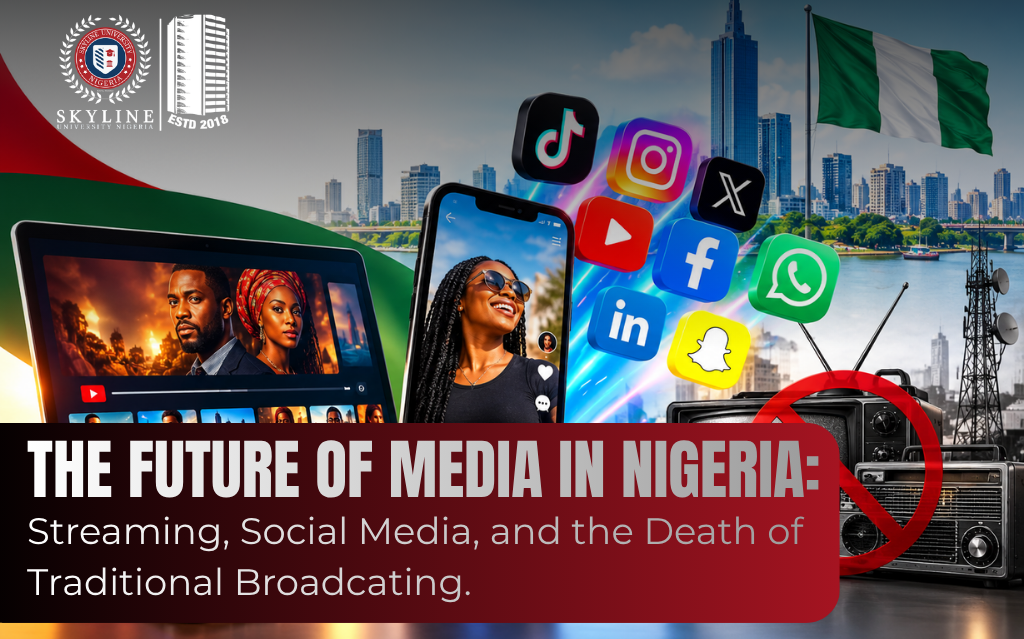
The Future of Media in Nigeria: Streaming, Social Media, and the Death of Traditional Broadcasting.

Nigeria’s media industry is undergoing a profound transformation, driven by digital technology, changing audience preferences and the growing influence of social media. Television, radio and newspapers, which once dominated information and entertainment, now compete with streaming services, online news platforms and content creators. However, the future is not necessarily the complete disappearance of traditional broadcasting. Rather, it is the emergence of a more connected, interactive and digitally driven media ecosystem. The Rise of Streaming Platforms Streaming has fundamentally changed how Nigerians consume entertainment. Platforms such as YouTube, Netflix and Showmax allow audiences to access films, documentaries, music and other content on demand, without depending entirely on conventional broadcasting schedules. This flexibility is particularly attractive to younger audiences who prefer personalised entertainment and mobile access. According to PwC (2025), Nigeria’s entertainment and media industry is experiencing digital-driven growth, with over-the-top streaming services contributing to changing consumption patterns. This creates opportunities for Nigerian filmmakers, musicians and independent producers to reach wider audiences and generate revenue beyond traditional distribution channels. Nevertheless, high data costs, unreliable electricity, limited purchasing power and uneven internet access continue to restrict participation, particularly among low-income households and rural communities. Social Media and the Democratization of Information Social media platforms, including Facebook, Instagram, TikTok, WhatsApp and X, have transformed news distribution and public engagement. Information now travels rapidly, enabling citizens, journalists and independent creators to report events, express opinions and participate in national conversations. DataReportal (2026) estimated that Nigeria had 109 million internet users and 47.8 million social media user identities by the end of 2025. These figures illustrate the expanding digital environment, although social media identities should not be interpreted as unique individuals. The Reuters Institute’s Digital News Report 2025 also highlights the growing importance of social platforms in news consumption, particularly Facebook, YouTube and X. This transformation has weakened traditional media’s exclusive control over information. However, it has also intensified concerns about misinformation, manipulated content, online harassment and declining public trust. Consequently, digital media organisations must prioritise fact-checking, responsible reporting and professional ethics. Is Traditional Broadcasting Dying? The phrase “death of traditional broadcasting” captures the pressure facing conventional media, but it risks overstating the situation. Radio and television remain important sources of news, education and public information, particularly for communities with limited internet access. Their established infrastructure, professional journalists and public-service responsibilities continue to provide considerable value. The real challenge is the decline of traditional broadcasting as a stand-alone model. Media organizations increasingly need to distribute content across television, radio, websites, podcasts, livestreams and social media. Broadcasters that combine professional journalism with digital accessibility can retain existing audiences while attracting younger generations. The Road Ahead The future of Nigerian media will depend on innovation, affordability, credibility and inclusion. Media organizations must invest in digital production, audience engagement, multimedia storytelling and sustainable revenue models. Policymakers and telecommunications providers should also address connectivity gaps and affordability while protecting freedom of expression. Ultimately, streaming and social media are not simply replacing traditional broadcasting; they are redefining its purpose and delivery. The organizations most likely to thrive will be those that embrace technological change without abandoning accuracy, accountability and public service. Nigeria’s media future will therefore belong not exclusively to traditional broadcasters or digital platforms, but to those capable of combining the strengths of both. References DataReportal. (2026). Digital 2026: Nigeria. https://datareportal.com/reports/digital-2026-nigeria PricewaterhouseCoopers (PwC). (2025). Africa Entertainment and Media Outlook 2025–2029. https://www.pwc.com/ng/en/publications/entertainment-and-media-outlook.html Reuters Institute for the Study of Journalism. (2025). Digital News Report 2025: Nigeria. University of Oxford. https://reutersinstitute.politics.ox.ac.uk/digital-news-report/2025/nigeria written By, Mr. Abdulsalam Mustapha.

The Future of Media in Nigeria: Streaming, Social Media, and the Death of Traditional Broadcasting. Read More »

Kano State Fire Service Conducts Fire Safety and Evacuation Drill Training for Skyline University Nigeria Staffs.

Skyline University Nigeria (SUN) recently hosted a comprehensive fire safety and evacuation drill training for all its staffs   , organised by the Kano State Fire Service. The programme was aimed at strengthening the university community’s preparedness and response capacity in the event of a fire emergency. The training and lectures were facilitated by experienced officers of the Kano State Fire Service, led by Ibrahim Umar Muhammad (HFS) and Sulaiman Ibrahim, alongside two other officers from the Service. The sessions combined theoretical instruction with practical demonstrations to ensure participants gained both knowledge and hands-on experience. Key areas covered during the training included: Basic principles of fire prevention and safety Identification of common fire hazards in workplace and academic environments Proper use of fire extinguishers and other firefighting equipment Safe and orderly evacuation procedures Emergency response protocols and coordination Staff members from various departments of the university actively participated in the practical evacuation drill, which simulated real-life emergency scenarios. The exercise emphasised the importance of remaining calm, following designated escape routes, and assembling at designated safe points. Speaking during the session, the facilitators from the Kano State Fire Service stressed that fire safety is a collective responsibility. They urged all members of the university community to remain vigilant, report potential hazards promptly, and familiarise themselves with emergency exits and assembly points across the campus. The management of Skyline University Nigeria expressed appreciation to the Kano State Fire Service for the timely and professional training. The university reaffirmed its commitment to prioritising the safety and well-being of its staff, students, and visitors by continuously investing in capacity-building programmes and safety awareness initiatives. This collaboration between Skyline University Nigeria and the Kano State Fire Service highlights the importance of institutional partnerships in promoting a culture of safety and preparedness within educational environments.

Kano State Fire Service Conducts Fire Safety and Evacuation Drill Training for Skyline University Nigeria Staffs. Read More »

Skyline University Nigeria Hosts ASHA International Model School for Changing Gear Session

Skyline University Nigeria (SUN) recently welcomed students of ASHA International Model School for its ongoing Changing Gear workshop series. The interactive session, held at the university auditorium, was designed to equip secondary school students with practical skills and career insights that will guide them toward informed academic and professional decisions. Lecturers from the School of Science and Information Technology and the School of Arts, Management and Social Sciences delivered presentations on emerging tools powered by Artificial Intelligence and navigating student life in the era of social media. The programme forms part of Skyline University Nigeria’s commitment to nurturing young minds and bridging the gap between secondary education and higher learning. ASHA International Model School students actively participated in the discussions, reflecting their readiness to embrace the opportunities that lie ahead.

Skyline University Nigeria Hosts ASHA International Model School for Changing Gear Session Read More »

Prime College Kano Students Explore AI-Powered Video Creation at Skyline University Nigeria.

Students of Prime College, Kano, participated in a Changing Gear session at Skyline University Nigeria, where they were introduced to artificial intelligence (AI)-powered video creation and a range of AI tools designed to enhance creativity and digital content production. The session provided students with practical insights into how artificial intelligence can be used to develop engaging video content, transform creative ideas into visual stories, and explore innovative approaches to digital media production. Through the introduction to various AI tools, participants gained a better understanding of the growing role of technology in modern creative processes. The programme also highlighted the importance of developing digital skills among young people, particularly as artificial intelligence continues to reshape the media, communication, and creative industries. By exploring these emerging technologies, students were encouraged to embrace innovation, experiment with new ideas, and build skills that can support their academic pursuits and future careers. The Changing Gear initiative reflects Skyline University Nigeria’s commitment to promoting practical learning, technological awareness, and innovation among young people. Through interactive learning experiences, the university continues to create opportunities for students to discover emerging technologies and understand their real-world applications. The participation of Prime College students underscores the importance of introducing young learners to digital tools that encourage creativity, critical thinking, and technological advancement. As artificial intelligence continues to open new possibilities in content creation and digital communication, initiatives such as Changing Gear provide a platform for young people to explore these opportunities and prepare for an increasingly technology-driven future.

Prime College Kano Students Explore AI-Powered Video Creation at Skyline University Nigeria. Read More »

Skyline University Nigeria Signs MoU with LawGPT Ltd and Law.AI Ltd to Advance Legal Education Through Artificial Intelligence.

Skyline University Nigeria has entered into a strategic Memorandum of Understanding (MoU) with LawGPT Ltd and Law.AI Ltd to strengthen legal education, professional development and the adoption of Artificial Intelligence in legal practice and learning. The agreement, signed on 2 October 2026, establishes a collaborative framework focused on three major areas: the adoption of a Legal Education AI platform, the establishment of a co-branded AI-in-Law Certification Academy, and joint capacity-building programmes for legal professionals and educators. Under the agreement, students and staff of Skyline University Nigeria will have access to a specialized Legal Education AI platform featuring more than 50 tools designed to support Socratic case analysis, moot court preparation, Nigerian legal research, dissertation drafting and other aspects of legal education. The partnership will also introduce a joint Certification Academy, offering specialized four-week courses covering areas including AI in Legal Practice, AI in Vocational Legal Training, AI for Lawyers, AI-Powered Legal Research and Legal Writing, as well as the use of tools such as Gemini and other AI technologies. Through the collaboration, Skyline University Nigeria and LawGPT/Law.AI will jointly issue co-branded certificates, while Skyline lecturers will have opportunities to participate in the training and certification programmes. Beyond students and lecturers, the partnership will extend to the wider legal profession through joint CPD masterclasses and executive retreats designed for judges, magistrates, prosecutors, senior advocates, lawyers, regulators, government legal officers, law teachers, professors and postgraduate supervisors. The capacity-building sessions will feature practical demonstrations of AI-powered legal tools, including LawAI, Virtual Judge and Legal Education AI, providing participants with opportunities to explore how emerging technologies can support legal research, education and professional practice. As part of the agreement, LawGPT/Law.AI will provide a free on-campus demonstration and training opportunities for Skyline staff and students, while both institutions will collaborate on co-branded marketing, certification and professional development initiatives. The MoU, which is initially set to run for three years, reflects Skyline University Nigeria’s commitment to integrating emerging technologies into academic and professional education. This partnership represents another step towards preparing students and professionals for a rapidly changing legal landscape where technology, artificial intelligence and legal expertise increasingly intersect. Driving Innovation in Legal Education Through this collaboration, Skyline University Nigeria continues to position itself as an institution committed to innovation, digital transformation and industry-relevant education, equipping its students and academic community with the knowledge and tools needed to thrive in the future of work.

Skyline University Nigeria Signs MoU with LawGPT Ltd and Law.AI Ltd to Advance Legal Education Through Artificial Intelligence. Read More »

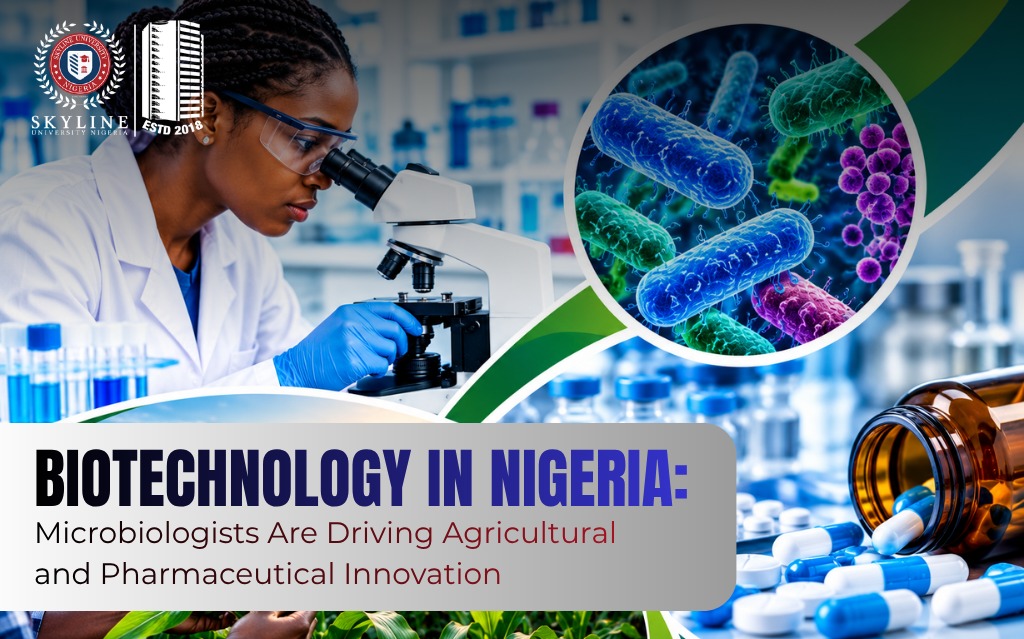
Biotechnology in Nigeria: How Microbiologists Are Driving Agricultural and Pharmaceutical Innovation.

Introduction Biotechnology is transforming the way we produce food, prevent diseases, and improve human health. It involves using living organisms, cells, or biological processes to develop useful products and technologies. In Nigeria, microbiologists play an important role in this transformation by studying microorganisms such as bacteria, fungi, and viruses and applying their knowledge to solve real-life problems. From improving soil fertility to discovering new medicines, microbiology is helping Nigeria explore locally available biological resources, strengthen food security, and support pharmaceutical development. Transforming Agriculture Through Microbial Biotechnology Agriculture remains an important part of Nigeria’s economy, providing food, employment, and income for millions of people. However, farmers face challenges such as declining soil fertility, crop diseases, and high costs of chemical fertilizers and pesticides. Microbiologists are addressing these challenges through the application of beneficial microorganisms. Certain bacteria, such as Rhizobium and Azotobacter, can improve the availability of nutrients in soil, particularly nitrogen, which plants need for healthy growth. Similarly, mycorrhizal fungi form beneficial relationships with plant roots, helping crops absorb water and essential minerals. These microorganisms can be developed into biofertilizers, offering farmers environmentally friendly alternatives or supplements to conventional fertilizers. Other beneficial microbes are used in the development of biopesticides, which help control agricultural pests and plant diseases while reducing dependence on synthetic chemicals. Microbiology also supports the production of fermented foods such as yoghurt, cheese, and traditional Nigerian food products. Through controlled fermentation, microorganisms improve food preservation, flavour, and, in some cases, nutritional quality. These applications create opportunities for local food processing, entrepreneurship, and employment. Advancing Pharmaceutical Innovation Microbiologists also contribute significantly to pharmaceutical research and healthcare development. Many important medicines originate from microorganisms. For example, Penicillium fungi are associated with the discovery of penicillin, one of the earliest antibiotics that transformed the treatment of bacterial infections. In Nigeria, microbiologists investigate bacteria, fungi, and other biological resources to identify potentially useful antimicrobial compounds. This research is particularly important because antimicrobial resistance, which occurs when microorganisms no longer respond effectively to medicines, threatens the successful treatment of infections. Microbiologists also contribute to vaccine research, disease diagnosis, quality control of pharmaceutical products, and the development of biological products. Through molecular biology, genetic engineering, and microbial biotechnology, researchers can investigate new approaches to disease prevention and treatment. The World Health Organization has identified local pharmaceutical, vaccine, and biological production as important components of Nigeria’s healthcare development. This creates opportunities for microbiologists, pharmacists, biotechnologists, and other scientists to collaborate in strengthening local research and manufacturing capacity. Building a Healthier and More Sustainable Nigeria Despite these opportunities, biotechnology development in Nigeria faces challenges, including inadequate research funding, limited laboratory infrastructure, and the need for stronger collaboration between universities, industries, and government agencies. Addressing these challenges requires sustained investment in scientific research, modern laboratory facilities, professional training, and the commercialization of research findings. Ultimately, biotechnology demonstrates that microorganisms are not merely agents of disease; they are valuable biological resources capable of improving human life. Through their contributions to agriculture, food production, medicine, and environmental sustainability, microbiologists are helping Nigeria develop practical solutions to national challenges. As Nigeria continues to strengthen its scientific and technological capacity, microbiologists will remain essential to building a more productive agricultural sector, a stronger pharmaceutical industry, and a healthier society. Figure 1. Application of microbial biotechnology in agriculture, food production, pharmaceutical research, and healthcare innovation in Nigeria. References Salisu, B. U., & Isiya, S. (2024). Biofertilizer production using phosphate-solubilizing Pseudomonas specie isolated from rhizosphere soil: Towards indigenous biofertilizer for enhanced crop productivity in Katsina, Nigeria. UMYU Journal of Microbiology Research, 9(1), 123-133. World Health Organization. (2024). A case study on the ecosystem for local production of pharmaceuticals, vaccines, and biologicals: the Nigeria context. World Health Organization. Oluwamakinde, E. P., Akpofure, O. D., Adeniran, S. O., & Fagbenro, O. S. (2026). Integrating advanced molecular biotechnology tools into toxicological research infrastructure for sustainable development in Nigeria. Discover Toxicology, 3(1), 1. written by/ Abdulsalam Mustapha Head of Department, Microbiology, Skyline University Nigeria  

Biotechnology in Nigeria: How Microbiologists Are Driving Agricultural and Pharmaceutical Innovation. Read More »